Bedside Book of Philosophy by Gregory Bassham
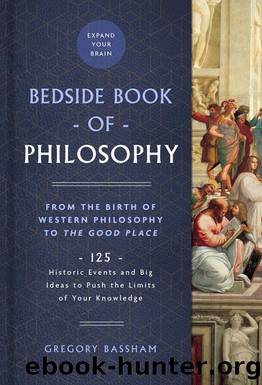
Author:Gregory Bassham [Bassham, Gregory]
Language: eng
Format: epub
Published: 2021-08-03T00:00:00+00:00
An engraving after the noted portrait of Rousseau painted by Scottish artist Allan Ramsay in 1766 when Rousseau came to Britain.
SEE ALSO The Enlightenment Begins (1620), Emile and Natural Education (1762)
1762
THE SOCIAL CONTRACT
Jean-Jacques Rousseau (1712â78)
ROUSSEAU HAD A PROFOUND IMPACT not only on philosophy, but also on politics, literature, art, education, and manners. His influence on Romanticism and education will be considered in other entries. Here we look at his political thought, particularly as expressed in The Social Contract, his most important book.
Rousseau, who led a turbulent and troubled life, was born in Geneva, Switzerland, in 1712, the son of a poor watchmaker. After his father abandoned the family around 1724, Rousseau largely raised and educated himself. His first book, Discourse on the Arts and Sciences (1750), shocked French Enlightenment thinkers such as Diderot and Voltaire by attacking civilization, science, and reason. His next major work, Discourse on the Origins of Inequality (1755), argued that humans are naturally good; painted an idyllic picture of a primitive, pre-social state of nature; and blamed private property as the origin of oppressive inequalities. In The Social Contract (1762), Rousseau made clear that he wasnât attacking government and social order per se. On the contrary, he argued, only through organized communities can humans truly be ethical and free.
The problem Rousseau wrestles with in The Social Contract is how to reconcile government and freedom. When humans decide to leave the state of nature by creating governments and laws, they surrender their ânatural libertyâ to do as they please, unhindered by laws or other people. But in creating governments they acquire a higher type of freedom that Rousseau calls âcivil liberty.â True liberty, he argues, is living under laws that we ourselves have made. When humans elect to leave the state of nature and form a community, they create an artificial person, a sovereign body, with a will of its ownââthe general willââwhich is basically the collective desire to promote the common good. Fostering the communal good, he says, is also our own âreal will,â what all of us explicitly or implicitly desire. Therefore there is no real sacrifice of freedom when we obey laws, even those with which we may strongly disagree. In fact, lawbreakers may be âforced to be freeâ by state coercion, a notion that many contemporary philosophers regard as paradoxical and fraught with peril.
Download
This site does not store any files on its server. We only index and link to content provided by other sites. Please contact the content providers to delete copyright contents if any and email us, we'll remove relevant links or contents immediately.
| Anthropology | Archaeology |
| Philosophy | Politics & Government |
| Social Sciences | Sociology |
| Women's Studies |
The remains of the day by Kazuo Ishiguro(8961)
Tools of Titans by Timothy Ferriss(8359)
Giovanni's Room by James Baldwin(7313)
The Black Swan by Nassim Nicholas Taleb(7097)
Inner Engineering: A Yogi's Guide to Joy by Sadhguru(6782)
The Way of Zen by Alan W. Watts(6589)
Asking the Right Questions: A Guide to Critical Thinking by M. Neil Browne & Stuart M. Keeley(5751)
The Power of Now: A Guide to Spiritual Enlightenment by Eckhart Tolle(5741)
The Six Wives Of Henry VIII (WOMEN IN HISTORY) by Fraser Antonia(5493)
Astrophysics for People in a Hurry by Neil DeGrasse Tyson(5172)
Housekeeping by Marilynne Robinson(4432)
12 Rules for Life by Jordan B. Peterson(4298)
Double Down (Diary of a Wimpy Kid Book 11) by Jeff Kinney(4257)
The Ethical Slut by Janet W. Hardy(4235)
Skin in the Game by Nassim Nicholas Taleb(4231)
Ikigai by Héctor García & Francesc Miralles(4228)
The Art of Happiness by The Dalai Lama(4118)
Skin in the Game: Hidden Asymmetries in Daily Life by Nassim Nicholas Taleb(3986)
Walking by Henry David Thoreau(3948)
